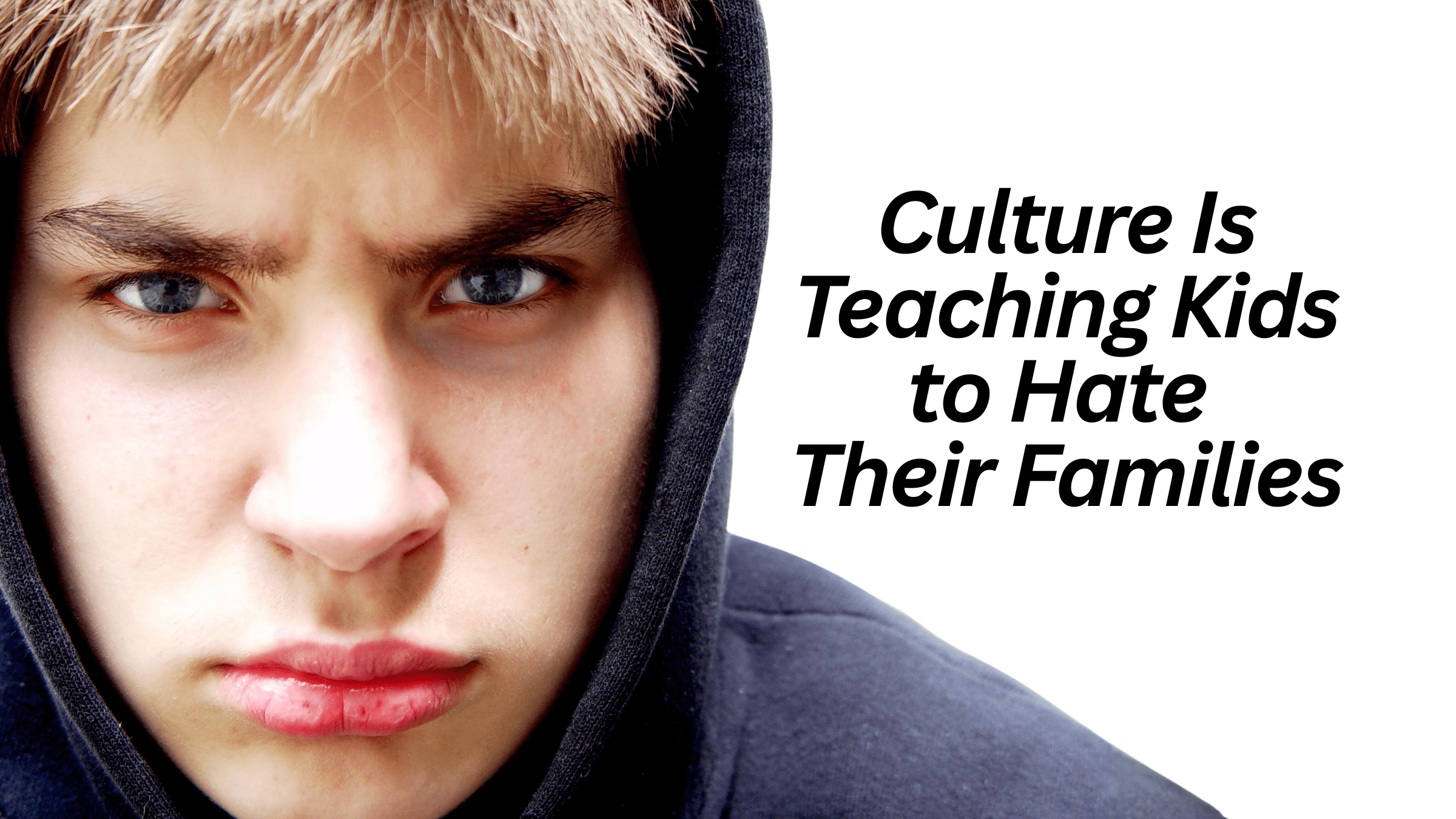
Over the past several years, I’ve watched a heartbreaking trend unfold across our culture—one that I encounter regularly in our parents’ ministry and one that is increasingly being normalized on social media. More and more adult children are cutting off their parents, going “no contact,” rewriting their childhoods, and framing nearly every relational tension as “abusive” or “toxic.”
And it’s tearing families apart.
This isn’t just an isolated issue anymore. It’s becoming a cultural movement—one fueled by individualism, skewed therapeutic models, and a social environment where everything is perceived through the lens of trauma. As Christians, we need to pay attention to what’s happening.
Because culture is discipling our kids… and it’s teaching them to hate their families.
The Rewrite: When Perception Becomes “Truth”
One of the most alarming patterns I see today is how many young adults are rewriting their childhood stories—sometimes dramatically. In many cases, the memories they describe simply do not match reality. Their siblings often recall completely different experiences, and their parents are left stunned by what’s being claimed. I see this especially prevalent after a child “comes out” as LGBTQ, however it is happening to families in all circumstances, belief systems, and backgrounds.
Why is this happening?
Because we now live in a cultural moment where perception is reality. What I feel must be true. What I experienced emotionally must carry more weight than what actually happened. But Scripture teaches us that there is only one truth, not multiple conflicting “my truths.” In a world that denies the truth that each of us is a sinner in need of Jesus as our Savior, many adult children have lost the ability to look inward and recognize their own sin as the root of their turmoil. Instead, they look outward—and the first people they see are their parents. Blaming them becomes not only easy, but fashionable.
This doesn’t mean real abuse never occurs—of course it does. I minister to the victims of abuse daily. And it must be addressed with compassion, justice, and honesty. But we must also acknowledge that sometimes our personal perceptions are shaped by our own brokenness, sin, bias, or immaturity.
As I’ve grown older, God has humbled me many times by revealing ways my own perceptions were skewed. Sometimes I was right about parts of a situation… but wrong about others. That self-awareness is vital for healing and reconciliation.
Why Are So Many Kids Going No-Contact?
There are valid reasons to distance oneself from certain relationships. But what we’re seeing today is different. Many young adults are cutting off parents not because of severe harm, but because of discomfort, disagreement, or perceived “toxicity.”
And culture cheers them on.
Everywhere online, you can find therapists, influencers, and advocates encouraging estrangement with simplistic slogans:
- “You deserve peace.”
- “Anyone who makes you uncomfortable is unsafe.”
- “Cut out toxic people—even family.”
This mindset erases the complexity of human relationships. It reduces conflict to trauma, accountability to abuse, disagreement to harm. And when this ideology takes root, parents end up not only losing their relationship with their adult kids, but also access to their grandchildren—creating deep, generational instability. We now live in a culture where disagreement is perceived as hatred.
Even Secular Voices Are Noticing
I was shocked to see an article from The Atlantic— progressive publication—acknowledge the severity of family estrangement. Josh Coleman wrote about America’s “love affair with individualism,” noting that we increasingly view cutting off family not as tragic, but as courageous.
His article concludes with a powerful reminder:
“We may see cutting off family members as courageous rather than avoidant or selfish… There are relationships that don’t need to be lost forever.”
For The Atlantic to issue that warning says a lot about how extreme the trend has become. The pushback in the comment section was beyond severe, with thousands of people doubling down on their perceptions–and ideology–which led to their chosen estrangement.
When Everything Is “Abusive”
Many of the parents we minister to are facing accusations that simply do not match reality. Their adult children describe childhood events that never happened or interpret discipline, structure, or ordinary conflict through the lens of abuse.
Some reasons:
1. The trauma language explosion
Words like “abusive,” “toxic,” “unsafe,” and “harmful” have become catch-all terms for anything that makes us uncomfortable.
2. Therapeutic overreach in schools
Books like Bad Therapy (Abigail Shrier) show how untested emotional-learning practices can actually plant suspicion in kids’ minds toward their parents—suggesting problems that weren’t there.
3. The coddling of a generation
Well-meaning parents (and cultural forces) have raised many young adults with fragile emotional resiliency. This has led to a worldview where discomfort is seen as trauma rather than a normal part of life. See The Coddling of the American Mind by Jonathan Haidt.
4. Extreme individualism
We now believe we need no one—not family, not church, not community. Autonomy has become the highest virtue. It has been engrained in us for decades. First, families become independent from society. And now people are becoming independent from their families. A rejection of authority, submission, respect, and honor echo through not only our families–but our view of God.
This combination is deadly for family relationships.
5. Critical Theory
Critical Theory teaches that the world is full of power structures in which oppressors use power to oppress others. They believe that power structures must be resisted, torn down, and destroyed. When applied to the family, it means that the family structure is a social construct designed to enslave. Therefore escaping this dynamic is brings freedom.
The James Dobson Controversy
Dr. James Dobson passed away recently, and while there were countless testimonies of his positive impact on families, the online backlash was staggering. People accused him of causing “generations of abuse”—not because of actual harm, but because he believed in biblical discipline or traditional Christian parenting.
Some commenters even suggested he was in hell simply for teaching parents how to raise their kids.
That reaction says far more about the state of our culture than about Dr. Dobson.
In reality, millions of families—including mine—were stronger because of his ministry. Were his teachings perfect? Of course not. But test everything; hold fast to what is good (1 Thess. 5:21). And the good was substantial.
How We Got Here: Three Cultural Forces
1. Secular therapeutic ideology
Not all therapy is bad. But some therapeutic trends—especially when applied indiscriminately in schools—encourage children to reinterpret normal family dynamics as harmful.
2. Radical individualism
We’ve created a culture where independence is idolized and family dependence is viewed as weakness.
3. The breakdown of the multigenerational home
For most of human history, families worked together, lived together, discipled one another, and stayed connected across generations. Since the Industrial Revolution, work has taken Mom and Dad out of the home. Extended families have fractured. Young adults are encouraged to disconnect.
This isolation fuels estrangement.
God’s Vision for Family
Scripture consistently emphasizes family, lineage, blessing, and legacy. God designed families—and even extended families—to be a stabilizing force in our lives.
When the ideal is broken, God’s grace is sufficient.
But we cannot pretend that severing family ties is healthy, normal, or biblical.
God calls us toward humility, repentance, forgiveness, and relational endurance—not abandonment.
And when reconciliation isn’t possible, the church becomes the family of God, stepping in to support, disciple, and walk alongside those who lack family stability.
While God’s vision of marriage does involve “leaving and cleaving,” (Matt 19:5), there are extremes and overcorrections on every side. One side involves continued emotional entanglement to one’s family of origin, which is detrimental to the new marriage. However, much of today’s phenomenon is an extreme over correction: generational abandonment.
A Call to Wisdom and Discernment
If you’re wrestling with your upbringing, here are some questions worth praying through:
- Are my perceptions influenced by pain rather than truth?
- Have I sought wise, biblical counsel rather than only therapeutic or online voices?
- Am I viewing discomfort as trauma?
- Am I seeking reconciliation or escape?
- Have I examined my own sin, pride, or bias?
- Am I honoring my parents as Scripture commands, even if boundaries are needed?
And for parents:
- Have you humbly acknowledged your imperfections?
- Are you open to understanding your adult children’s perspective?
- Have you invited trusted believers to help discern truth from distortion?
- How can you be a blessing to your kids, and their kids, in these season of their lives?
Estrangement is sometimes necessary in extreme situations—but it should never be our default.
Final Thoughts
We are witnessing a cultural shift that is redefining family, parenting, and truth itself. The enemy would love nothing more than to divide the generations, sow bitterness, and fracture families that God designed for stability and blessing.
But there is hope.
God’s grace is enough to redeem broken stories, restore strained relationships, and correct distorted perceptions. The church can step in where the family fails. And with humility, courage, and discernment, we can resist the lies of a culture that encourages us to abandon the people who raised us.Families matter.
Generations matter.
Truth matters.
And God is still in the business of reconciliation.
0 Comments